Skip to content

Four phases

Roadmap

Each phase works on its own and earns the next one with real results.

Phase One: The tethered Nautilus, original concept illustration

Phase One

The tethered Nautilus

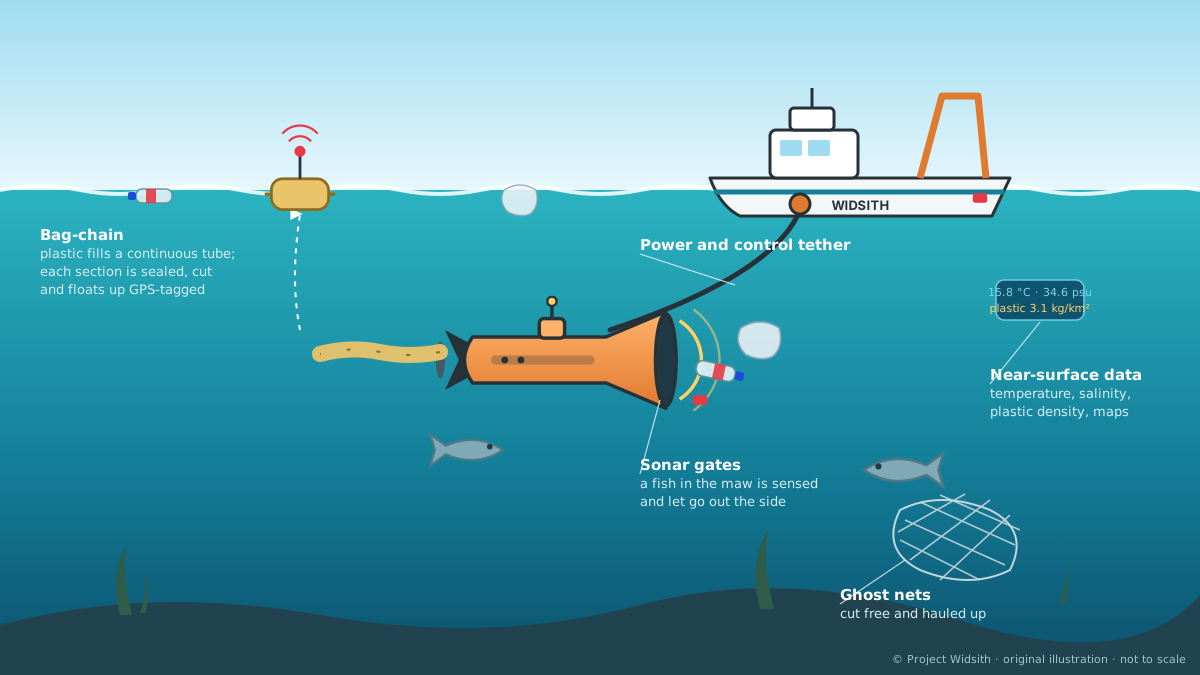
A simple all-electric drone, powered and steered through a cable from a small support boat. Propellers and fins for steering, intake maws with sonar gates, and the bag-chain that seals the catch into bales and sends them up the tether to the boat, so it keeps working instead of going back to empty.

  • Harbors, marinas and river mouths, where plastic gathers before it reaches the open sea
  • Ghost nets: found and mapped with sonar and marked for removal crews; lost nets keep killing turtles, seals and fish for years
  • Calm water, short trips, results people can see
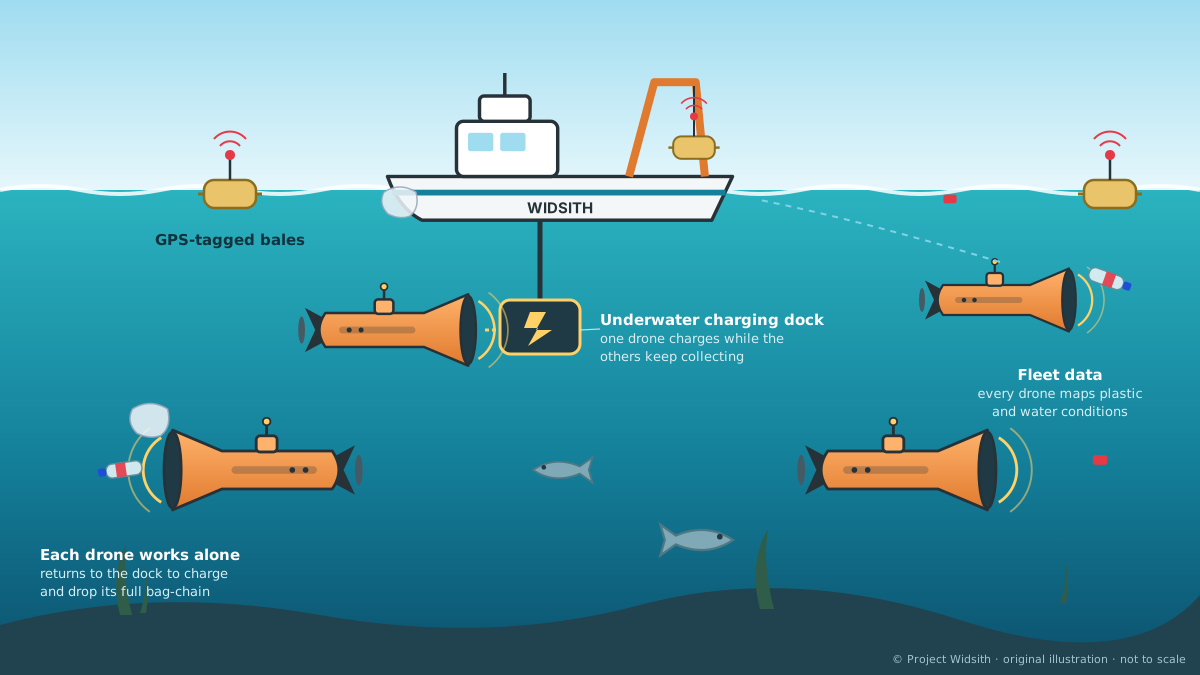
Phase Two: The Nautilus fleet, original concept illustration

Phase Two

The Nautilus fleet

Autonomous battery drones that work like a robot vacuum. When power runs low, each returns to a charging dock hanging under the support ship, one at a time, while the others keep collecting. Underwater docking and charging already exists for survey drones, so this phase builds on proven technology.

  • Several drones per ship
  • Bales lifted aboard by the ship's crane
  • Fleet-wide plastic and water maps
Phase Three: The long-range Nautilus, original concept illustration

Phase Three

The long-range Nautilus

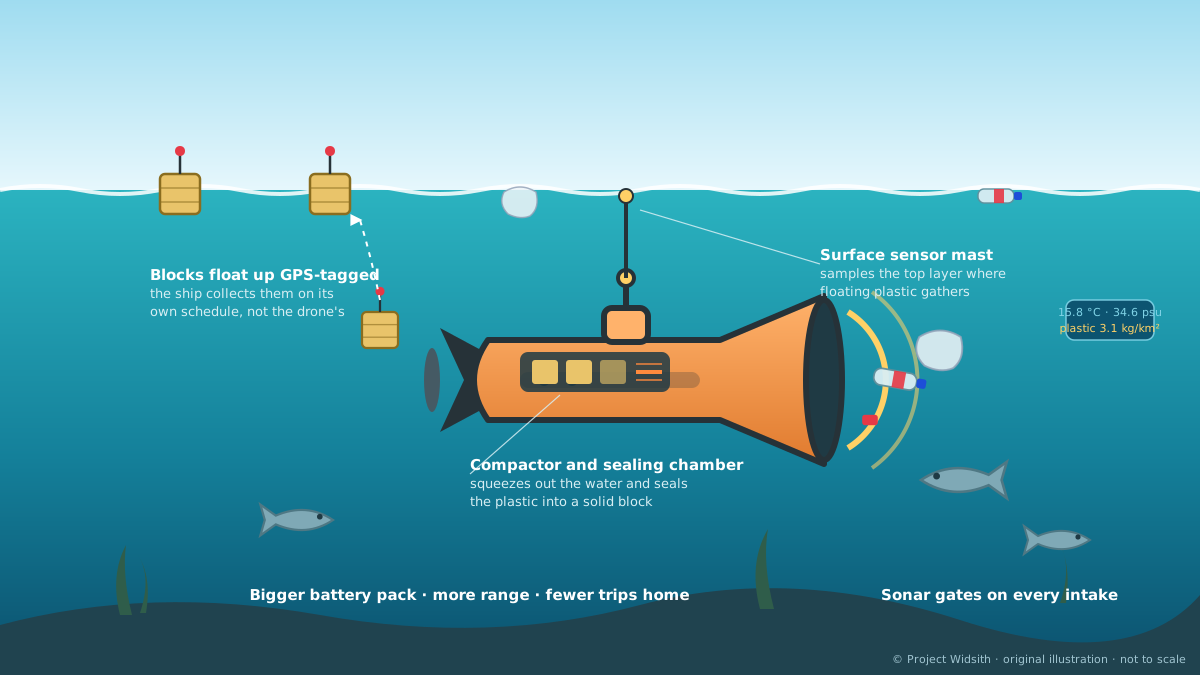
A larger drone with a much bigger battery that works for days without the ship. Its compactor squeezes out the water and seals the plastic into solid blocks that float up, tagged, for the ship to collect on its own schedule. A sensor mast samples the top layer of water, where floating plastic gathers.

  • Days at sea without a ship alongside
  • Solid, sealed blocks: nothing left to drift
  • Bigger battery, more range, fewer trips home
Phase Four: The endgame, original concept illustration

Phase Four

The endgame

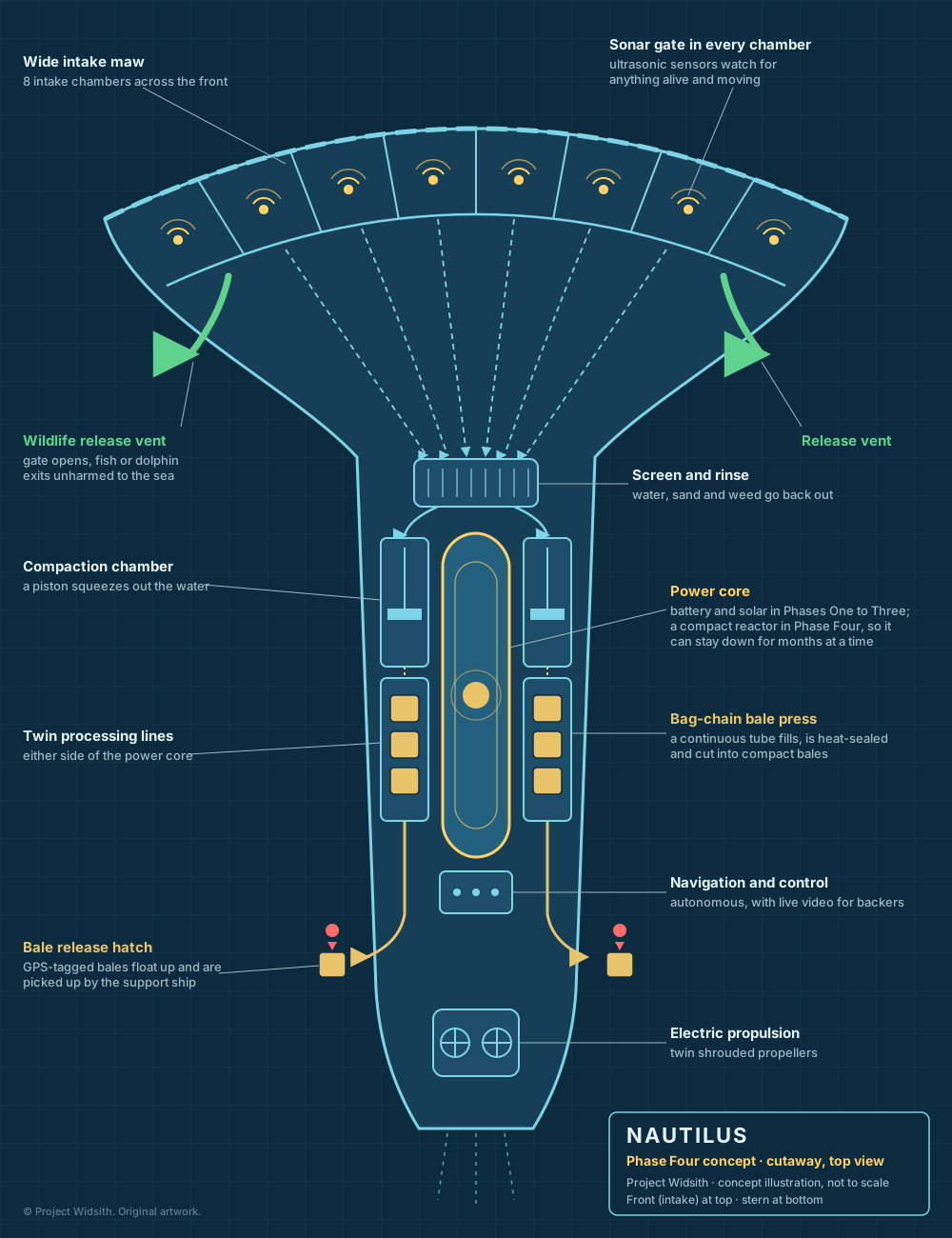
The long-term vision: a large autonomous Nautilus, 150 to 200 feet long, that never needs to surface. A wide maw feeds many intake chambers, each with sonar gates and baffles that turn living things back to the sea, around a central power core. Battery, solar and wave power carry Phases One to Three; the final stage is a compact nuclear power core, so the Nautilus can stay down for months at a time.

  • Shipping fleets paid a bounty to bring blocks to port
  • Recovered plastic becomes feedstock where it can be recycled
  • A compact nuclear core, developed with a licensed nuclear-engineering partner

Phase One

First design targets.

Honest numbers for a small first drone, to be tested in a tank and then a calm harbor. A slow drone with a narrow maw covers little open water, which is why Phase One works where trash already gathers: harbors, foam lines and river mouths.

TargetPhase One prototype
SizeAbout 2 m (6 to 7 ft) long
Power and controlTether from a small support boat: power, video and steering
MawAbout 1 m wide, with a sonar gate on each intake
Collecting speedNo more than about 0.3 knot (0.15 m/s). A scoop takes in water at the drone's own speed, so the slow-intake promise sets the pace.
ShiftAbout 8 hours, by daylight
Ground coveredAbout 4 km of 1 m swath a shift, roughly 4,000 m²
BalesPassed up the tether to the boat; never left adrift
Ghost netsFound with sonar, logged and marked for removal crews
Catch per dayTo be measured in the tank and harbor trials

Where we are

The road to the first mission.

Design stage: building the team for the Phase One prototype.

  1. Done The idea Concept, the four phases and the first artwork.
  2. Now Build the team Engineers, marine scientists and a university student team for the Phase One design.
  3. Next Form the organization The legal home for grants, sponsors and donations.
  4. Next Phase One prototype A tethered test drone: tank tests, then a calm harbor.
  5. Next First mission A harbor or river mouth with a local partner, filmed for everyone to follow.
  6. Later Follow the Nautilus The live map and drone camera app, with ocean-mile sponsors.