A wide front maw
is designed to take in floating and drifting plastic as the drone moves just below the surface, or skims the surface itself in calm water.

How every Nautilus is designed to work
is designed to take in floating and drifting plastic as the drone moves just below the surface, or skims the surface itself in calm water.
on every intake will sense anything alive and swimming. A fish, turtle or dolphin is let out the side before anything is compacted.
no pumps and no blades: a slow intake and a rinse-back screen return water, weed and small drifting life to the sea.
plastic fills a long tube that is sealed and cut into bales: up the tether to the boat in Phase One, floating up with a GPS tag in later phases. The drone keeps working instead of going home to empty.
every Nautilus will measure temperature, salinity and plastic density as it travels, building live maps of where plastic gathers.
lost nets keep killing for years. The Nautilus maps them with sonar below the surface and marks them for removal crews, rather than trying to swallow them.
From the ocean to the recycler
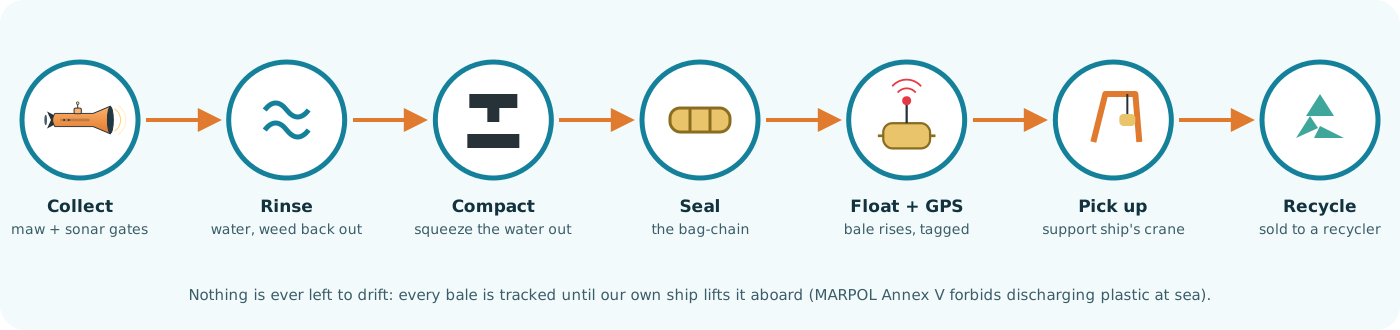
Like a self-cleaning litter box, the Nautilus is designed to pack its catch into a continuous tube that is heat-sealed and cut into bales. In Phase One the bales go straight up the tether to the support boat; from Phase Two on, full bales float up wearing a GPS tag and the ship's crane lifts them aboard. No bale is ever left adrift. Ashore they go to a recycling partner where the plastic can be recycled, and are disposed of properly where it cannot.
Two ways to work
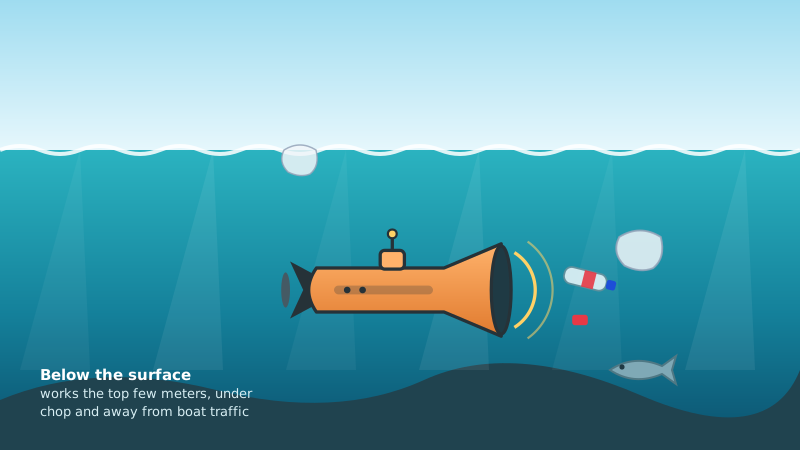
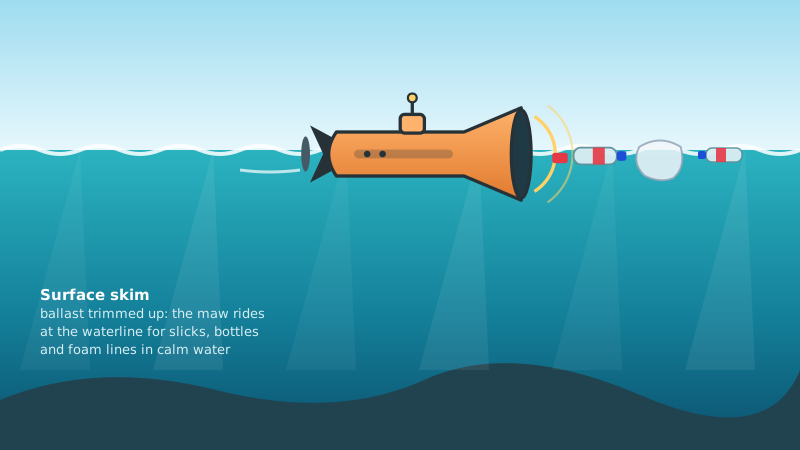
The same drone is designed to change its trim. Below the surface it works under the chop, away from boat traffic. Trimmed up, its maw rides the waterline to sweep up bottles, foam and floating slicks.
Sea life first
The fair criticism of ocean cleanup is that it catches living things along with the plastic. We take that seriously. Animals that swim are sensed by sonar and let out through a side gate. For life that drifts and cannot swim away, the answer is not a gadget but how the drone is built and where and when it works.
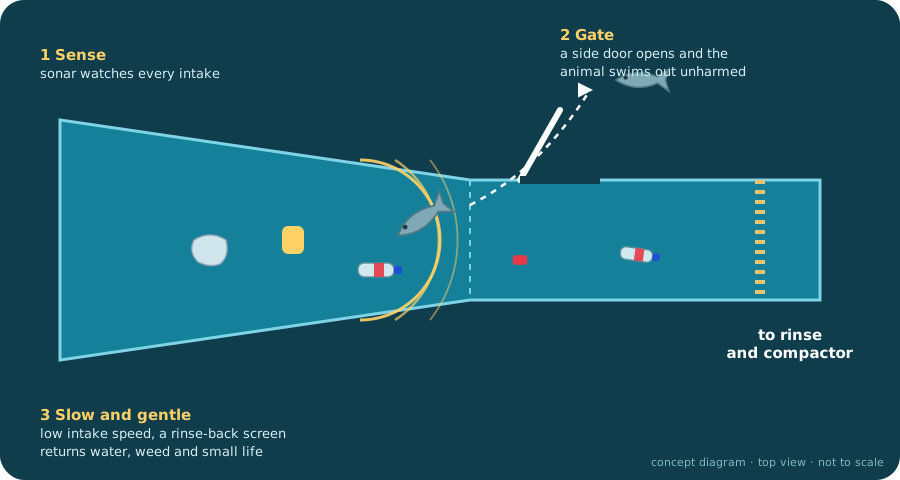
While collecting, the drone moves slowly (about 0.3 knot), so water enters the maw slower than a small fish can swim, through a passive scoop and a slow belt. Nothing is pumped or chopped.
Screens of 5 to 10 mm and more keep the plastic and let plankton, eggs and larvae pass straight through.
Before anything is compacted the catch waits in a holding bay, is rinsed with seawater, and a live-return chute sends animals back out.
A forward camera spots jellyfish and floating animals such as by-the-wind sailors, and pauses the intake and steers around them.
Daylight work by default, when far fewer drifting animals are at the surface, and no skimming of sargassum mats. Harbors, river mouths and ghost nets first, where floating life is sparse.
Every animal returned is logged on camera, and the numbers are published. Our critics should be able to check our work.
Why not an electric field? Electric fish barriers only work on animals that can feel the field and swim away. Plankton, eggs and jellyfish drift, so they would be carried in anyway, and electric fields can harm eggs and larvae. Seawater also conducts so well that a useful field would drain the battery. Sonar, lights and a slow intake do the job better.
A second mission
The Nautilus will travel through the top layer of the ocean anyway, so it can measure it: temperature, salinity, water quality and, above all, where plastic gathers and how much there is.
Today most plastic counts come from nets towed behind research boats and sorted in a lab. A Nautilus fleet would map it continuously, and that data is useful to universities, fisheries and science programs.
Good company
We looked at what exists today. Several excellent projects tackle pieces of ocean plastic; we found no underwater drone that collects drifting plastic the way the Nautilus would.
| Project | What it does |
|---|---|
| The Ocean Cleanup | Large surface barriers towed through the Great Pacific Garbage Patch, plus river Interceptors. |
| Mr. Trash Wheel (Baltimore) | Solar- and water-powered wheels that catch trash at river mouths. |
| Clearbot, WasteShark | Small surface boats that skim trash in harbors. |
| SeaClear (EU) | A robot team that picks litter off the seafloor; still in trials. |
| Ghost-gear groups | Global Ghost Gear Initiative, Healthy Seas and others find and remove lost nets, mostly with divers. |
| Ocean-data drones | Saildrones and gliders stay out for months collecting data, but collect no plastic. |