
Skip to content

About

About

A cause liberals and conservatives can both get behind.

The name

Widsith: the far traveller.

Widsith is one of the oldest poems in the English language. Its name means “far-traveller”: a wanderer who has crossed the known world and tells what he found there. It felt right for a drone that will travel the ocean and report back what it finds.

The drone itself is the Nautilus, after the shelled sea creature that has drifted the oceans for hundreds of millions of years, and the submarine of Jules Verne. Its spiral is our badge.

How it started.

The project started in 2020 as a short document and three hand drawings. The question behind it hasn't changed: what could people on both sides agree on? Plastic in the ocean hurts fishermen and beach towns, wildlife and tourism, red states and blue states alike. The Nautilus is a practical, buildable answer, one phase at a time.
Common ground

Clean oceans aren't left or right.

Project Widsith began with a question from a niece: what could we build that liberals and conservatives would both support? Getting plastic out of the ocean is one of the very few causes almost nobody opposes. Cleaner beaches, healthier fisheries, safer wildlife, and a practical engineering answer paid for by people who choose to back it.

Washington agrees. The Save Our Seas 2.0 Act, signed in December 2020, was sponsored by Republican and Democratic senators together.

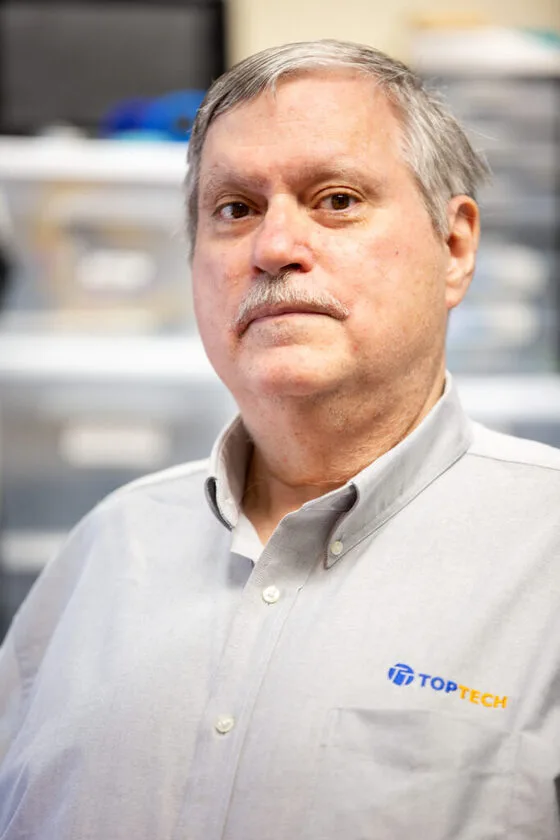
Craig Baker, founder of Project Widsith

Who's behind it

Craig Baker

Founder of CDB Systems, known online as The Eldest Geek. Fifty years at the keyboard, and a career that started on the ocean at NOAA.

Where it started: radar on the ocean

He studied at Trinity College Dublin, earning degrees in theoretical physics and mathematics and a master's in mathematics, then returned to Colorado for a master's in computer science at the University of Colorado. From there NOAA hired him as a programmer at the Wave Propagation Laboratory in Boulder, in the Sea State Studies group. On the lab's Digital Equipment Corporation PDP-11/60 and 11/34 computers he helped develop the software that turned a phased-array radar looking out over the ocean into maps of wave heights and current directions.

The work earned several awards, among them a $10,000 cash award that brought the Secretary of Commerce to Boulder to present it. After a number of years, with no challenges left there, he moved to the private sector and founded CDB Systems, and has spent the decades since building and repairing computers.

Project Widsith brings him back to the ocean. It is independent and self-funded so far. Everything you see here was designed in-house; the next step is building the team that turns it into hardware.

Questions

Fair questions, straight answers.

Does the Nautilus exist yet?

Not yet. Today it is a design and a plan. The next step is a Phase One prototype built with a university team, tested in a tank and then a calm harbor.

Won't it catch fish too?

Swimming animals are sensed by sonar and let out through side gates. For drifting life we use a slow intake with no pumps, mesh sized for plastic, a rinse-and-return step before compaction, cameras that pause the intake, and daylight work away from sargassum. We will count and publish every animal returned.

What happens to the plastic?

It will be sealed into bales that our own support boat collects and takes to a recycling partner. Plastic that has been at sea is often too weathered to recycle, so what can't be recycled is disposed of properly on land. Nothing is melted or dumped at sea: international law forbids discharging plastic at sea, and we wouldn't anyway.

Why start in harbors and rivers?

Most ocean plastic arrives through rivers and coasts, and floating sea life is sparse there. Calm water also makes the first missions safe, short and easy to film.

Why nuclear in Phase Four?

Only at the very end, for a large drone that stays down for months. Phases One to Three run on battery, solar and wave power. A nuclear core would be developed with a licensed nuclear-engineering partner, under the same rules as any reactor at sea.

How is it funded?

Self-funded so far. Next come sponsors, a first fundraiser for the prototype, and grants once the prototype is in the water.